
Research article / Open Access
2023; 1(1): 131- 135. doi: 10.31488/JPP.106
Injection of 35kDa Hyaluronan Fragment Alleviates Pain Associated with Radiotherapy for Treatment of Colorectal and Rectal Cancer
K. Dashnyam≠2, D. Treger≠5, XX. Jia4, MA. Gantumur4, A. Bayanmunkh3, J. Hui3, B. Ganbaatar4, H. Wang1, M. Hui*4, ZC. Zhang*1
1.Department of Radiotherapy, Qingdao United Hospital, Qingdao, Shandong, People’s Republic of China
2.Drug Research Institute, Mongolian University of Pharmaceutical Science, Ulaanbaatar, Mongolia
3.Department of Biology, School of Arts and Sciences, National University of Mongolia, Ulaanbaatar, Mongolia
4.Qingdao Hui Nuo De Biotechnology Inc, Hynaut Group, Qingdao, Shandong, People’s Republic of China
5.Miller School of Medicine, University of Miami,Miami, FL 33136, United States5. Miller School of Medicine, University of Miami,Miami, FL 33136, United States
*Corresponding author:M. Hui, Qingdao Hui Nuo De Biotechnology Inc, Hynaut Group, Qingdao, Shandong, People’s Republic of China ≠K. Dashnyam and D. Treger contribute equally .
Abstract
The previous study has shown that a naked mole rat that has a high tissue content of hyaluronan and its fragments is insensitive to pain. The previous study has also shown that hyaluronan modulates pain-regulated TRPV1 channel opening, reducing peripheral nociceptor activity and pain. The previous study has again shown that local injection of 35 kDa hyaluronan fragment HA35 is effective in treating inflammatory and neuropathic pain. This study employs a freshly made HA35 injection for treatment of pain associated with radiotherapy for treatment of colorectal and rectal cancer. A numerical rating scale from 0 to 10 was used to assess the pain after 1 hour, 3 hours, 24 hours, 48 hours and 72 hours of the injection. The results in this study indicate that HA35 of 100mg of abdominal deep fat layer injection effectively alleviates pain associated with radiotherapy, suggesting its important role in palliative care for patients with advanced colorectal and rectal cancer.
Keywords:35 kDa hyaluronan fragment, HA35, pain, colorectal cancer, rectal cancer
Introduction
Hyaluronan (HA) has a high molecular weight, high viscosity, low solubility in aqueous solutions, and poor permeability in human tissues. Therefore, HA is mainly used for local injections. HA and its constantly degraded fragments have a variety of binding proteins or receptors [1-4], including CD44, LYVE-1, RHAMM, HARE, Siglec-9, TLR2, CEMIP and TMEM2, suggesting their wide range of bioactivities. It has been reported that the content of HA and its fragments in the tissue of African naked mole rats is as high as 6%. Studies have shown that high levels of HA and its fragments make them insensitive to acid induced pain and do not suffer from cancer for life, suggesting that HA and its fragments have powerful analgesic and anticancer effects [5-7]. A new study was published in a recent issue of Nature magazine that utilized a gene transfer method to overcome the poor tissue permeability of gel-like high molecular weight HA [8]. In the gene transferred mice’s organs and tissues, high levels of HA and its fragments are achieved by the expression of naked mole rat HA synthase 2 gene (nmrHas2). The nmrHas2 gene-transferred mice accumulated high molecular weight HA and its fragments in multiple organs; these mice were resistant to spontaneous and induced cancer as well as inflammation including, inflammatory pain [7,8].
Previous clinical study showed that the molecular weight 35 kDa hyaluronan fragment HA35 extracted from human colostrum was safe for human use [9]. Previous study also showed that the molecular weight 35 kDa hyaluronan fragment HA35 (Bioactive HA or B-HA or HA35) was successfully made by the mixture of hyaluronidase PH20 and injection-degraded high molecular weight HA at room temperature for 4 hours which are safe for human use [9,10]. HA35 (Bioactive HA or B-HA or HA35) has good tissue permeability (B-HA injection, Ministry of Health, Registration number L20200708MP07707). HA35 might not lose HA’s bioactivities of binding to a variety of HA’s binding proteins or receptors, including the analgesic and anticancer effects of HA, therefore being named bioactive HA or B-HA [10] (B-HA injection, Ministry of Health, Registration number L20200708MP07707). The results of the clinical studies indicated that HA35 or B-HA effectively treated inflammatory and neuropathic pain as well as chronic wounds (Registration number NCT05756595 and NCT05764226, www.clinicaltrials.com).
In this study, freshly made 100mg of HA35 or B-HA is injected into abdominal deep fat layer. The clinical effect of the injection in treatment of pain associated with radiotherapy for colorectal and rectal cancer is studied by employing a short-term self-controlled clinical study, namely investigator initiated trials (IIT) [15,16]. A numerical rating scale from 0 to 10 was used to assess the pain after 1 hour, 3 hours, 24 hours, 48 hours and 72 hours of the injection [17-18]. The results in this study indicate that the freshly made 35 kDa hyaluronan fragment HA35 or B-HA of 100mg of abdominal deep fat layer injection effectively alleviates pain associated with radiotherapy for the treatment of colorectal and rectal cancer.
Materials and Methods
A total of 2000 units of bovine testis hyaluronidase PH20 (hyaluronidase for injection H31022111, P.R.C) and 100 mg high molecular weight HA (sodium hyaluronate for injection, H20174089, P.R.C) were mixed at room temperature for 20 minutes, then was locally injected into patient’s abdominal deep fat layer by a registered nurse or a physician in order to quickly alleviate pain associated with radiotherapy for treatment colorectal and rectal cancer. Then, a numerical rating scale (NRS) from 0 to 10 was used to assess the pain after 1 hour, 3 hours, 24 hours, 48 hours and 72 hours of the injection [17,18].
All the freshly made HA35 or B-HA samples were diluted to a final concentration of 5 mg/ml. Then, diluted samples and standards were mixed 4:1 with a loading buffer. Electrophoresis was conducted at 80 V for 20 min. The gel was destained for 2 hours until the sample band was clearly visible, and the 1% agarose gel was photographed under a bright light.
Online GPC-MALLS combined with a refractive index detector (RID) was used to analyze the molecular weight of the freshly made HA35 or B-HA samples. Chromatographic conditions were as follows: high-performance liquid chromatography (HPLC) (with a RID); a Shodex SB-804 HQ gel column (8mmX300mm); mobile phase 0.02 % sodium azide; flow rate 1ml/min; injection volume 100 μl; temperature 40 C; and detector RID and MALLS.
To determine the relative molecular mass of each sample, an appropriate amount of sample was weighed to prepare 1 mg/ml polysaccharide solution, which was filtered for HPLC analysis. For the molecular mass distribution, the mass concentration and light scattering intensity at different angles were measured by an RID and a laser detector, respectively. The refractive index increment (dn/dc) value was 0.138. The molecular mass distribution map of the test samples was obtained using the data processing software ASTRA.
The filter membrane with a 220 nm pore size was used to filter freshly made HA35 or B-HA injection in order to test its human tissue permeability as a <220 nm nanoparticle.
This study was approved by a constituted review board (Ethics Committee of the Qingdao United Hospital). Written informed consent was obtained from all 10 patient volunteers per the guidelines of the Declaration of Helsinki as most recently amended in 2013. All the patients were enrolled in the study between October 2023 and December 2023.
In this study, 10 patients with radiotherapy for the treatment of colorectal and rectal cancer were studied in their residence, Qingdao, Shandong, People’s Republic of China. All patients had different degrees of metastasis of the cancers, including bone metastasis. All patients undergo targeted radiotherapy shortly before this study. All the patient volunteers included in this study were allowed to use antibiotic compounds on and off during the treatment in order to prevent possible infections associated with the cancers for ethnic consideration. The included patients were aged 48 to 60 years.
Statistical analyses with SPSS v.24 (IBM Corp., Armonk, NY, USA) were employed in the present study. Continuous data were evaluated for normality and homogeneity using Student's t-test. Normally distributed data were expressed as the mean (SD) and were analyzed by one-way analysis of variance (ANOVA). A P value <0.05 was viewed as statistically significant.* represents p<0.05; ** represents p<0.01; *** represents p<0.001; **** represents p<0.0001.
Result
Molecular weight determination
Bovine testis hyaluronidase PH20 (hyaluronidase for injection H31022111, P.R.C) cleaved high molecular weight HA injection (sodium hyaluronate for injection, H20174089, P.R.C) into 35 kDa hyaluronan fragment HA35 (Figure 1). In figure 1, bovine testis hyaluronidase PH20 with activity units of 20,000 U/g enzymatically cleaved high molecular weight HA for 60 min (Lane 1), 50 min (Lane 2), 40 min (Lane 3), 30 min (Lane 4), 20 min (Lane 5) and 10 min (Lane 6). Lane 7 and Lane 8 were molecular standards for 10 kDa and 50 kDa HA fragments, respectively. The samples were electrophoresed for 1 hour.
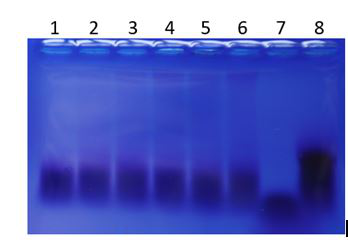
Figure 1:Electrophoresis results of bovine testis hyaluronidase pH 20 enzymatic digestion of high molecular weight HA raw material for 60 min (Lane 1), 50 min (Lane 2), 40 min (Lane 3), 30 min (Lane 4), 20 min (Lane 5) and 10 min (Lane 6). Lane 7 and Lane 8 were molecular standards for 10 kDa and 50 kDa HA fragments, respectively.
Table 1.Molecular weight of hyaluronan fragment generated by enzymatically cleavage of high molecular weight HA by bovine testis hyaluronidase pH20 and recombinant human hyaluronidase pH20 was measured by GPC-MALLS method.
| Index | Molecular weight (kDa) | Number(n |
|---|---|---|
| Molecular weight of hyaluronan fragment obtained by bovine testis PH20 cleavage of HA | 35.0±0.6 | 3 |
| Molecular weight of Hyaluronan fragment obtained by recombinant human hyaluronidase PH20 cleavage of HA | 35.6±0.5 | 3 |
| Hyaluronan fragment standard of 50kDa | 50.0±0.7 | 3 |
In this study, bovine testis hyaluronidase PH20 and recombinant human hyaluronidase pH20 (Shaoxing HUIHUI Technology Inc, Zhejiang Province, P.R.C) were mixed with high molecular-weight HA (sodium hyaluronate for injection, H20174089, P.R.C) at room temperature for 20 minutes to produce 35 kDa hyaluronan fragment HA35 (Table 1). The molecular weight of hyaluronan fragment of HA cleaved enzymatically by bovine testis hyaluronidase PH20 and recombinant human hyaluronidase pH20 was measured by GPC-MALLS method. The results are expressed as the mean standard deviation or number.
General data analysis
The 10 patient volunteers in this study (5 male and 5 female) had an average age of 52±4 years, a maximum age of 60 years, and a minimum age of 48 years (Table 2). Among them, 5 patients had rectal cancer; 5 patients had colorectal cancer (Table 2). The two patients of rectal cancer had bone metastasis and bone pain (Table 2).
Table 2.General data of all the patient volunteers
| Patients Number(n) | 10 |
|---|---|
| Age (ys) | 52±4 |
| Male, n (%) | 5(50%) |
| Female, n (%) | 5(50%) |
| Body weight (kg | 67±11 |
| rectal cancer, n (%) | 5(50%) |
| colorectal cancer, n (%) | 5(50%) |
| Pain or discomfort, n (%) | 10(100%) |
| Radiotherapy, n (%) | 10(100%) |
| Days after the radiotherapy | 4±3 |
| Metastasis, n (%) | 10(100%) |
| Bone metastasis, n (%) | 2(20%) |
NRS assessment of pain or discomfort
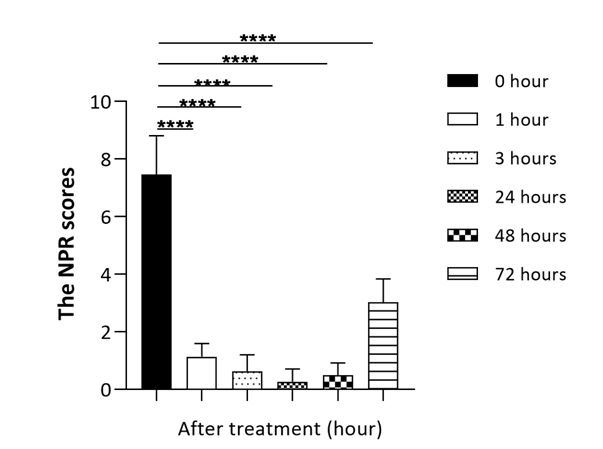
Figure 2:Pain or discomfort scores before and after the treatment: 0 painless, 1-3 mild pain (pain does not affect sleep), 4-6 moderate pain, 7-9 severe pain (can not fall asleep or wake up in sleep), 10 severe pains; P value <0.05 was viewed as statistically significant; * represents p<0.05; ** represents p<0.01; *** represents p<0.001; **** represents p< 0.0001.
After treatment, the NRS scores of 1 hour, 3 hours, 24 hours, 48 hours and 72 hours after the injection [17,18] significantly decreased when compared with those of 0 hour or before treatment (Figure 2). The NPR score of patients at 0 hour or before treatment was 7.5±1.4. The NPR scores at 1 hour, 3 hours, 24 hours, 48 hours and 72 hours are 1.1±0.5, 0.6±0.6, 0.3±0.4, 0.5±0.4 and 3.0±0.8 respectively. After one day of the injection, the pain symptom was almost completely reduced (Figure 2).
Discussion
In this study, both bovine testis hyaluronidase PH20 and recombinant human hyaluronidase pH20 cleaved high molecular-weight HA into 35 kDa hyaluronan fragment HA35 at room temperature for 20 minutes (Figure 1 and Table 1). This freshly made 35 kDa hyaluronan fragment HA35 or B-HA freely pass through the filter membrane with 220nm pore size, suggesting its good human tissue permeability as <220nm nanoparticles. It was most probably that 35 kDa hyaluronan fragment HA35 or B-HA overcomes the poor tissue permeability of high molecular weight HA and is capable of entering human tissues to bind to a variety of HA binding proteins or receptors and is able to produce bioactivities such as the analgesic effect [11].
Recent studies have shown that overexpression of hyaluronan and its fragments in mouse tissues by gene transfer technology reduces the occurrence and development of malignant tumors and inflammation, including inflammatory pain in mice [7,8]. Previous published study showed that HA modulates pain-regulated TRPV1 channel opening, reducing peripheral nociceptor activity and pain (11). Our previous research has shown that local injection of 35 kDa hyaluronan fragment HA35 is effective in treating inflammatory and neuropathic pain (Registration number NCT05756595 at www.clinicaltrials.com).
This study employs the injection of freshly made 35 kDa hyaluronan fragments HA35 or B-HA for treatment of pain associated with radiotherapy for treatment of colorectal and rectal cancer [15].
Radiation therapy is often used to treat rectal cancer (https://www.cancer.org/cancer/types/colon-rectal-cancer/treating/radiation-therapy.html). Different types of radiation therapy can be used to treat colorectal and rectal cancers, including external-beam radiation therapy and internal radiation therapy. External-beam radiation therapy is the type of radiation therapy used on cancer from a machine outside the body. Internal radiation therapy is a radioactive source which is put inside your colorectum or rectum next to or into the colorectal or rectal tumor. This allows the radiation to reach the rectum without passing through the skin and other tissues of the abdomen. The radiation therapy causes pain or discomfort of skin, colorectum and rectum irritation, which can cause painful bowel movements, blood in the stool and stool leakage (https://www.cancerresearchuk.org/about-cancer/bowel-cancer/treatment/treatment-rectal/radiotherapy/side-effects) [19]. The radiation therapy also causes bladder irritation, which can cause problems like burning or pain [19]. The radiation therapy again causes scarring, fibrosis (stiffening), and adhesions that cause the tissues in the treated area to stick to each other [19]. All the pain associated with radiotherapy for treatment of colorectal and rectal cancer will lead to a decline in the quality of life of patients and create additional psychological burden [19-21]. Thus, treatment of the pain associated with radiotherapy for treatment of colorectal and rectal cancer is important part for palliative care for patients with advanced colorectal and rectal cancer, particularly those under radiotherapy [20-21].
The results in this study indicate that the freshly made 35 kDa hyaluronan fragment HA35 or B-HA of 100mg of abdominal deep fat layer injection effectively alleviates pain associated with radiotherapy for treatment of colorectal and rectal cancer (Figure 2). In all the cases, the pain was greatly relieved within 1 hour after the injection (Figure 2). Interestingly, the first injection’s pain relieving effect lasted for two days (Figure 2). At least, all the patients got a good night sleep for at least two days after the first injection (data not shown). The two patients of rectal cancer with bone metastasis had bone pain, including bottom and foot pain (Table 2). Surprisingly, the bone pain was also relieved after the injection.
Previous clinical study showed that HA35 extracted from human colostrum was safe for human use [9]. In this study, no complains of any side-effect were reported by the patients.
Pain management is an important aspect of palliative care for advanced colorectal and rectal cancer. The above results support the use of 35 kDa hyaluronan fragment HA35 or B-HA injection (Ministry of Health, Registration number L20200708MP07707) as palliative care therapy for the advanced colorectal and rectal cancer [20-23]
Conclusion
HA35 injection effectively alleviates pain associated with radiotherapy for treatment of colorectal and rectal cancer; 2. HA35 injection plays an important role in palliative care for patients with advanced colorectal and rectal cancer under radiotherapy.
References
1. Laurent UBG, Reed RK. Turnover of hyaluronan in the tissues. Advanced Drug Delivery Reviews. 1991; 7(2):237-256.
2. Fraser J R E, Laurent T C, Laurent U B G. Hyaluronan: its nature, distribution, functions and turnover. J Internal Med. 1997; 242(1):27-33.
3. Lena, Lebel. Clearance of hyaluronan from the circulation. Advanced Drug Delivery Reviews. 1991; 7:221-235.
4. Johnson LA, Jackson DG. Hyaluronan and Its Receptors: Key Mediators of Immune Cell Entry and Trafficking in the Lymphatic System. Cells. 2021;10(8):2061. doi: 10.3390/cells10082061. PMID: 34440831; PMCID: PMC8393520.
5. Andrei Seluanov et al. Mechanisms of cancer resistance in long-lived mammals. Nature Reviews Cancer. 2018;18:433–441.
6. Xiao Tian et al. High-molecular-mass hyaluronan mediates the cancer resistance of the naked mole rat. Nature. doi:10.1038/nature12234.
7. Ewan St. John Smith et al. The Molecular Basis of Acid Insensitivity in the African Naked Mole-Rat. Science. 2011;334:1557–1560.
8. Zhang ZH, Tian X, Lu JY, Boit K, Ablaeva J, Zakusilo FT, et al. Increased hyaluronan by naked mole-rat Has2 improves healthspan in mice. Nature. 2023;621:196-205. doi: 10.1038/s41586-023-06463-0.
9. Bellar A, Kessler SP, Obery DR, Sangwan N, Welch N, Nagy LE, et al. Safety of Hyaluronan 35 in Healthy Human Subjects: A Pilot Study. Nutrients. 2019;11(5):1135.
10. Jia X, Shi M, Wang Q, Hui J, Shofaro JH, Erkhembayar R, et al. Anti-Inflammatory Effects of the 35kDa Hyaluronic Acid Fragment (B-HA/HA35). J Inflamm Res. 2023; 16:209-224.
11. Caires R, Luis E, Taberner FJ, Fernandez-Ballester G, Ferrer-Montiel A, Balazs EA, et al. Hyaluronan modulates TRPV1 channel opening, reducing peripheral nociceptor activity and pain. Nat Commun. 2015;6:8095. doi: 10.1038/ncomms9095.
12. Hill DR, Rho HK, Kessler SP, Amin R, Homer CR, McDonald C, et al. Human milk hyaluronan enhances innate defense of the intestinal epithelium. J Biol Chem. 2013;288(40):29090-104. doi: 10.1074/jbc.M113.468629. Epub 2013 Aug 15. PMID: 23950179; PMCID: PMC3790008.
13. Marco Fogli,Nicola Giordan,Gianni Mazzoni. Efficacy and safety of hyaluronic acid (500-730kDa) ultrasound-guided injections on painful tendinopathies: a prospective, open label, clinical study,Muscles, Ligaments and Tendons J. 2017;7 (2):388-395.
14. Seyed Ahmad Raeissadat, Farshad Nouri, Mahtab Darvish, Hadi Esmaily, Parsa, Ghazihosseini. Ultrasound-Guided Injection of High Molecular Weight Hyaluronic Acid versus Corticosteroid in Management of Plantar Fasciitis: A 24-Week Randomized Clinical Trial, J Pain Res. 2020:13 109–121.
15. Konwar M, Bose D, Gogtay NJ, Thatte UM. Investigator-initiated studies: Challenges and solutions. Perspect Clin Res. 2018;9(4):179-183. doi: 10.4103/picr.PICR_106_18. PMID: 30319949; PMCID: PMC6176691.
16. Simmons CPL, MacLeod N, Laird BJA. Clinical management of pain in advanced lung cancer. Clin Med Insights Oncol. 2012;6:331-346. doi: 10.4137/CMO.S8360.
17. Cleland JA, Childs JD, Whitman JM. Psychometric properties of the Neck Disability Index and Numeric Pain Rating Scale in patients with mechanical neck pain. Arch Phys Med Rehabil. 2008; 89(1):69-74.
18. Vernon H, Mior S. The Neck Disability Index: a study of reliability and validity. J Manipulative Physiol Ther. 1991; 14(7):409-15.
19. Cameron MG, Kersten C, Vistad I, Fosså S, Guren MG. Palliative pelvic radiotherapy of symptomatic incurable rectal cancer-a systematic review. Acta Oncol. 2014;53(2):164-73. doi: 10.3109/0284186X.2013.837582. Epub 2013 Nov 6. PMID: 24195692; PMCID: PMC3894715.
20. Ronnekleiv-Kelly SM, Kennedy GD. Management of stage IV rectal cancer: palliative options. World J Gastroenterol. 2011;17(7):835-47. doi: 10.3748/wjg.v17.i7.835. PMID: 21412493; PMCID: PMC3051134.
21. Neibart SS, Manne SL, Jabbour SK. Quality of Life After Radiotherapy for Rectal and Anal Cancer. Curr Colorectal Cancer Rep. 2020 Feb;16(1):1-10. doi: 10.1007/s11888-019-00448-w. Epub 2020 Jan 16. PMID: 32632345; PMCID: PMC7336840.
22. Grond S, Zech D, Diefenbach C, Radbruch L, Lehmann KA. Assessment of cancer pain: a prospective evaluation in 2266 cancer patients referred to a pain service. Pain. 1996 Jan;64(1):107-114. doi: 10.1016/0304-3959(95)00076-3.
Chandrasekar D, Tribett E, Ramchandran K. Integrated palliative care and oncologic care in non-small-cell lung cancer. Curr Treat Options Oncol. 2016 May;17(5):23.
Received: December 02, 2023;
Accepted: December 20, 2023;
Published: December 24, 2023.
To cite this article : K Dashnyam, D Treger, XX Jia, MA Gantumur, A Bayanmunkh, J Hui, et al. Injection of 35kDa hyaluronan Fragment Alleviates Pain Associated with Radiotherapy for Treatment of Colorectal and Rectal Cancer. Pharmacology and pharmacogenomics. 2023; 1(1): 131-135. doi: 10.31488/jpp.106.
© The Author(s) 2023.